
Choosing the right Content Management System (CMS) for creating a good looking website with higher functionality can be critical decision which can impact your online business presence. Also, there are many options available for website development, which can be confusion as a beginner. In this article, we will explore some of the top 10 most popular CMS platforms in 2024, which can help you to make a proper decision that fits your business needs. We also break down each platforms which their available features, pros and cons that can provide insights on choosing the best CMS for your business.
Table of Contents
ToggleWhat is Content Management System (CMS)?
A Content Management System (CMS) is software that allows users to create, edit, manage, and modify the contents on a website without requiring specialized technical knowledge such as Blog, Video Posts, eBooks, News portals, business site, and e-commerce site. However, you may require some basic knowledge on using its interface and the functionality which can be learned easily without requiring the coding knowledge.
Types of CMS Platform
There are various types of CMS platforms available in the market. Some of the popular types of CMS platforms are explained below.
Open-Source CMS
Open-Source CMS platform are generally free to use and allow user to modify the code that fits your requirement. This means you to not have to pay any amount on installation, upgrade fees or contracts. However, using Open-source CMS might make some these following financial investments.
- Technical Support set-up and Installation
- Extending the software beyond the fundamental offering.
- Various add-ons and plugins
- Staff Training
- Other supports
Check out some of the popular Open-source CMS Platforms
- WordPress
- Joomla
- Drupal
- Magento
- PrestaShop
Proprietary CMS
These types of CMS system are known as commercial platforms that require a license to use. This means you to get their license to create a website which can be annually or monthly charge. Also, they come with customer support and regular updates which help your website stay updates and connected with the new available features. Here are some required investments when choosing a Proprietary CMS platform.
- Acquiring a License
- Paying for monthly or Yearly updates and Support
- Extra Costs can be included such as upgrades and personalization
Some of the Popular Proprietary CMS platform.
- Shopify
- Kentico
- Pulse CMS
- Sitecore
Headless CMS
These types of platform separate the back-end content management from the front-end presentation with more flexibility in providing content across the devices. Once it is developed, it can be spread through various devices such as smartphones, ioT devices, tablets, website and other channels.
Some of the Popular Headless CMS platform.
- Contentful
- Strapi
Cloud CMS
Cloud CMS is best suitable for small and medium sized businesses with higher level of functionality and requires some level of technical expertise with better support. There are two types of Cloud based content management i.e. Fully Cloud CMS and Partial Cloud CMS (Maria, 2023).
Why Choosing the Right CMS is important?
Impact on Website Performance
The CMS of the website can directly impact the performance of your website. A right CMS platform with well optimized can helps your website load faster, with better user experience, and improved search engine rankings. Otherwise, selecting the worst optimized CMS can slow down your website, which can lead higher bounce rate and lower conversions.
Scalability and Customization
As it is common, a growing business will have increased requirements for the website as well. Therefore, compatibility of a CMS with growth guarantees that a site can accommodate more traffic and content without affecting its performance. Moreover, options for personalization are important because they help design sites according to the individual demands and brand specification.
Ease of Use
Simplicity is the key particularly where beginners are concerned about using the CMS. For instance, there are interfaces that are friendly with drag-and-drop characteristics thus saving time used in learning. Nevertheless, complicated systems could have heightened customization and precautionary mechanisms among others; these features may appeal more towards individuals who have technically knowledge or specialized in this area.
Top 10 Most Popular CMS platforms in 2024
01
WordPress

WordPress is the most popular CMS platforms and free open-source that allows users to create, design, and manage the website easily without requiring any technical expertise. The platform was started as a blogging platform to share contents to their audiences but with time, the platform evolve into a multi-functional CMS which is presently used by millions of websites worldwide to create various types of website from a simple blog to a large e-commerce websites. WordPress is also known as open-Source CMS, as it is free to use and can be easily customized with thousands of themes and plugins that suits your website based on your requirements.
The platform powers over 40% of websites all over the world supported by numerous community of developers and users.
Types of WordPress
WordPress.com: It is a hosted version of WordPress. Here everything is managed for you from a hosting, maintenance to a security. It can be suitable for beginners with free plan as well. But when you get their premium plan, it is costlier than WordPress.org.
WordPress.org: If is a self-hosted WordPress. Which means you can have full control over your website. It is provided for free but you need to purchase a domain name and a web hosting. With wordpress.org, you can easily customize your site freely using various available free and premium themes. However, you need to maintain your website yourself and need to customize your website for higher security also.
Features of WordPress CMS platform
- Wide ranges of Plugins and Themes are available
- SEO Friendly with Clean Optimized
- User-Friendly Interface
- Strong Community Support
Websites Using WordPress CMS platform
Advantages and Limitations of WordPress CMS Platform
Advantages
- Free to use with Easy and Friendly Interface
- Highly customizable with available of thousands of free and premium themes and plugins
- Suitable for creating any types of website from a simple blog to a large e-commerce store.
Limitations
- Requires Regular Updates and Maintenance
- If you do not manage the platform properly, it can be vulnerable to security issues.
Ideal for: Bloggers, Small-Large sized businesses.
Useful Links:
- What is WordPress? Types of WordPress
- WordPress.com vs. WordPress.org
02
Joomla
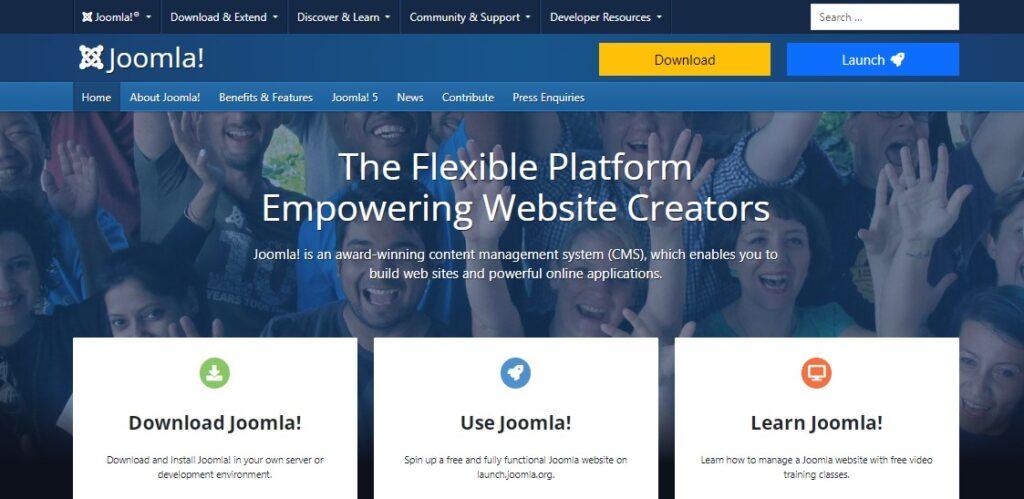
Joomla is another flexible, powerful, and most popular CMS platforms that allows users to create, design, and manage websites and applications. As Joomla is an open-source, it is free and can easily modify and customized by anyone. Also, with its easy user interface, it is best options for beginners and experienced developers to create a simple design website to a complex websites for large business organizations.
Joomla was developed in 2005 as a fork of the Mambo CMS. With time, the platform has grown to a large community of developers and has won several awards for it better functionality, easy to use and known as one of the top CMS platform in the world.
Joomla serves wide ranges of market for a small business to a large companies and government websites. Due to its advanced flexibility option, the platform can also be used for creating a e-commerce website, social networking sites, and online news portals. Like WordPress, the platform also provides wide number of free and premium templates and extensions that can be easily used by various business niches and their requirements.
Features of Joomla CMS Platform
- The platform offers advanced user management options with different access level and permission.
- Available support for multiple languages making it best for global market
- Available thousands of free and premium templates and extensions to enhance functionality and design
- SEO Friendly platform for better optimization of your contents
- Easy to use and manage your images, videos, and other files.
Advantages and Limitations of Joomla CMS Platform
Advantages
- The platform is highly flexibility and can be used to create different website from a small blog to a large companies.
- Joomla Platform supports multiple languages without the need of additional plugin.
- Joomla is a powerful platform with better user management features with different user roles and access levels for websites with various contributors.
- The platform provides free and premium templates and extensions for easy customization and enhancement of your website.
- Joomla does provide large and active community of developers and users who want to contribute support and resources.
- Joomla is known for its strong security features and regular updates, making it a secure choice for website development.
- Joomla Offers better SEO capabilities including SEO-Friendly URL, metadata management, and content optimization for SEO.
Limitations
- Comparing to other CMS platform like WordPress, Joomla can be more challenging for beginners to learn and use especially when you do not have technical knowledge.
- Joomla provides great but limited extension and templates for website development which sometime can be limited options.
- Joomla is less popular than WordPress therefore, there are less third party resources including tutorials, themes, and extensions.
- For small websites, the supports are very limited which might make the worst options. But for a larger and complex website, the platform is great.
Websites Using WordPress CMS platform
- Harvard University
- IKEA Fans
- Linux.com
- MTV Greece
- The Guggenheim
03
Drupal

Drupal is known for its powerful and highly customizable Content Management System (CMS) platform that is widely used for creating complex websites and web applications. The platform is widely used by developers and different organization looking for higher customization options that handles large amount of contents, multiple user roles, and complex workflows.
Drupal CMS is also open-source platform which is free to use and can be easily modified based on your requirement making it a popular choice for users to create a small website to a large companies sites.
The platform is developed by Dries Buytaert in 2001 as a message board which later evolved into a fully functional CMS platform. Drupal comes with several updates bringing significant improvement in functionality, security, and usability. The platform also has strong developer community that continuously contributes on development and growth of the platform and user.
Drupal platform is popular in the market due to its high level of customization options, security maintenance, and scalability. Therefore, it is widely used in government agencies, educational institutions, educational institutions, and large corporations. Also, due to its flexibility, the tool is used for creating various types of websites such as e-commerce, social networking sites and intranets.
Features of Drupal CMS Platform
- The most popular CMS platforms provides the best categorization options to organize content in multiple ways.
- It provides advanced user role management and permission system.
- The Platform provides and support multi-lingual websites.
- The platform has built-in SEO features with additional modules to optimize content for search engines.
- They provide high level of security features making the platform the most trusted for sensitive data and critical applications.
Advantages and Limitations of Drupal CMS Platform
Advantages
- The platform is highly customization with advanced available features, making it suitable for small websites to complex websites and applications
- Drupal platform provides better security features making it a suitable choice for government and large enterprise websites.
- The tool has strong community of developers and contributors to provide better support, updates, and new features.
Limitations
- Drupal can be difficult for beginners to learn, especially when they do not have any technical knowledge.
- The platform provides limited themes and modules compared to other CMS platform such as WordPress.
- The platform requires more server resources which can lead to higher hosting costs, mainly large companies’ sites.
Some Popular Websites Using Drupal CMS Platform
04
Magento

Looking for powerful and flexible e-commerce CMS platform to create and manage online store for your business? Magento can be a better option for your business which helps your businesses to create and manage your desired e-commerce store and sell the products. Like others, Magento is open-source, which helps your business modify and extend functionality to meet their specific needs.
Magento is suitable for small businesses and large enterprises with advanced e-commerce features. It offers with wide range of tools for managing products, customer orders, and promotion, making the platform the most popular to create an e-commerce store.
Magento was first released in 2008 by Varien, Inc. situated in California. The platform quickly gained popularity due to its flexibility and easy customization of an online store. In 2011, the platform is acquired by eBay and it was sold to a private equity firm and in 2018, Adobe acquired Magento.
Magento serves wide range of markets from a small to medium sized business and large enterprises. Magento is popular in various available industries such as fashion, electronics, and automotive businesses, where business requires advanced features like multi-store management, global selling capabilities, and high customization options.
The platform easily integrates with various third-party services making the tool more versatile solution for business looking for advanced e-commerce ecosystem.
Features of Magento CMS Platform
- Magento provides wide range of product customization, including configurable, bundled and grouped products.
- The platform help you manage multiple stores from a single admin interface, with easy handle different brands or regions.
- The platform is built-in tool for optimization for your online store for search engines including customizable URLs and Metadata.
- The themes and layout in Magento provides responsive design that can automatically adjust to different devices and screen sizes.
- The platform easily integrates with third party services like payment gateways, shipping providers and CMS systems.
- Magento provides security measures to protect against threats like data breaches and fraud.
Advantages and Limitations of Magento CMS Platform
Advantages
- Magento is highly scalable; therefore, the tool is suitable for different-size businesses from small startups to large enterprises.
- The platform offers high customization options allowing business to create and manage online store with specific needs.
- The platform manages multiple stores from a single backend, with easy handle different brands, products, or regions.
- The tool provides built-in SEO features to improve search engine rankings and drive organic traffic.
- The tool easily integrates with wide range of third party services including payment gateways, shipping providers and CRM system.
- The tool provides detailed analytics and reporting tools helping business make informed decisions based on data.
Limitations
- Magento provides complex features and customization options making it difficult for beginners to use without having technical expertise.
- The platform requires server resources, which can lead to higher hosting cost mainly online store.
- It can be sometime time consuming because the platform requires regular updates and maintenance to keep your website secure and run smoothly.
- If you do not properly optimize the platform, Magento can make your website slower mainly large website and mismanaged websites.
- For non-technical users, it can be a complex platform and requires some learning curve.
Some Popular Websites using Magento CMS Platform
05
PrestaShop

PrestaShop is an open source e-commerce platform that enables business to create and manage online store easily. The platform is suitable for both beginners and experienced developers to create and customize e-commerce website with wide range of features including Product management, payment gateways, and shipping option. Prestashop is suitable for small and medium sized business looking for creating an online business.
PrestaShop was founded in 2007 by a group of students from Epitech, a French IT with a mission to create a free and accessible e-commerce platform. With time and its popularity, the platform becomes the most used e-commerce platform all over the world with several major updates and adding more capabilities for modern online business.
With recent updates, Prestashop powers over 300,000 online stores worldwide and keeps increasing with time.
The platform is especially popular among small and medium sized businesses with cost-effective and e-commerce solution. The platform can be used for various market or niche such as fashion, electronic, and other products with multi-language support.
Features of PrestaShop CMS Platform
The tool easily allow you to manage products – categories, attributes, and stock level and support major payment gateway such as Paypal, Stripe, and Bank transfer.
The platform can easily configure various shipping methods and carriers with real-time tracking and cost calculation.
The platform is optimized with SEO features including customizable URLs and Meta tags.
Access detailed reports and analytics to track sales, customer behavior and other key metrics.
Advantages and Limitations of PrestaShop CMS Platform
Advantages
- PrestaShop is a free platform with large community contributing for its ongoing development, supports, and updates.
- The platform offers wide customization options allowing your businesses to create a fully functional online store with all necessary features.
- The platform offers wide customization options allowing your businesses to create a fully functional online store with all necessary features.
- With multi-language and multi-currency support, the platform can be used worldwide targeting international market.
Limitations
- Even though the platform has strong community, official support can be limited mainly for free users.
- Customization and managing can be confusing for new users; therefore they may require some technical expertise mainly for advanced features.
- The platform is free but for other useful modules and themes are paid which can add some cost when you start.
- There may arise some complexity and may requires additional assistance to avoid some issues during updating the PrestaShop into new version.
- Any open-source platform is security vulnerabilities is major concern; therefore, you need to manage and updates the platform regularly.
Some Popular Websites using PrestaShop CMS Platform
06
Shopify

Shopify is another leading e-commerce platform that allows you to create, manage, and customize online store easily with their easy user interface making it suitable for small and medium sized businesses without requiring technical expertise. Shopify offers wide range of tools and services including payment, payment processing, shipping option and marketing tools. Therefore, it makes a popular choice for business organization to establish an online presence quickly and efficiently.
Shopify was developed in 2006 by Tobias Lutke, Daniel Weinand, and Scott Lake in Ottawa, Canada. The platform was initially created to sell snowboarding equipments and understanding its flexibility, the platform is created for other users to build their online store.
Presently the platform powers over all million of business in more than 175 countries and is most widely used e-commerce platform globally.
The platform is popular among various e-commerce industry including fashion, beauty, home goods, and electronics. Also, the platform supports wide number of third party service and support multi-language channels making it best choices all over the world. As a Dropshipping business, it can be a suitable platform where you can easily start an online business without requiring any products into your warehouse or a physical store.
Features of Shopify Platform
The platform provides the simplest and easy user interface, making its users to set up and manage their online store without having any technical knowledge.
With their highly customizable features, and mobile friendly themes, you can easily create a professional looking online store and can be easily views on laptop, tablets, and smartphones.
The platform provides most of the required features that e-commerce store should have such as payment gateways, product and product management, and marketing resources.
They provide thousands of apps and plugins that extend the functionality of the store.
They provide 24/7 customer support through chat, email and phone to solve every issues that arise.
Advantages and Limitations of Shopify
Advantages
- With their easy and simplest user interface, you can easily create your own online store without having any technical knowledge.
- The platform provides 24/7 customer support, that help you to solve any issues arise through chat, email, and phone calls.
- Integration's with third party services related to payment, and product management, make your website more functional and easy to operate.
- Shopify takes care of all the security related activities; you can just focus on the selling your products and marketing your brands.
Limitations
- Shopify is not free for their users. They provide its users a certain days free trials, and later you need to get their premium pricing including the cost of their apps and themes as well.
- Shopify have higher customization options but it is not as flexible at other open-source platform such as WordPress, Magento, and Drupal; especially related to the backend customization.
- You need to highly depend on various apps which adds to overall cost and complexity of managing your store.
- Shopify has built-in SEO features but has some limited compared to other platform such as restricted URL structure control.
- Shopify’s blogging and content management capability is very limited to open-source platform like WordPress.
- Scalability is limited, as your business grows you might sometime need to move to other platform which can be challenging and may require professional help.
Some Popular Websites using Shopify
07
HubSpot CMS

HubSpot CMS is an extremely powerful matter management system (CMS) that allows businesses in creating, managing, and optimizing their websites. Based on HubSpot’s all-in-one marketing, sales and service platform, HubSpot CMS is designed for marketers and entrepreneurs who desire to develop engaging content that drives growth without needing deep technical skills.
Its features include amongst others; drag-and-drop editors, automatic SEO and in-depth integration with other marketing applications such as HubSpot’s CRM which makes it the best option for businesses looking to incorporate their site into larger marketing strategies.
HubSpot CMS was founded in 2006 by Brian Halligan and Dharmesh Shah as a marketing software company. And as a company grew, the platform extended its services offering various tools for marketing, sales, and customer service. In 2018, HubSport started a HubSpot CMS – a Content Management System that are easily integrated with companies existing tools and provides solutions for creating and managing website focusing on marketing and selling the products and services.
The platform is suitable for small and medium sized businesses and marketing companies which provide value to your business. HubSpot CMS is also used by agencies that manage multiple clients and allows for easy content updates and maintenance across various websites.
Features of HubSpot CMS
- The platform provides drag and drop user interface, which allows you to create and edit sites without needing coding skill.
- Easy to integrate your website HubSpot CRM and track visitor interaction and grow leads.
- HubSpot includes built-in security features, such as SSL certificates and Web Application Firewall (WAF) to protect your website.
Advantages and Limitations of HubSpot CRM
Advantages
- HubSport is all-in-one Platform meaning it can easily integrates with HubSpot marketing, sales, and service tools, providing comprehensive solution for business.
- The platform provides drag-and-drop editor and built-in tools to make easy for non-technical users to manage and update your website.
- HubSpot CRM allows its users for advanced content personalization improving user engagement and conversion rates.
- The platform provides security features like SSL certificates and a Web Application Firewall to protect your website from threats.
Limitations
- HubSpot is more expensive that other CMS platforms, mainly for smaller businesses with limited budgets.
- There might be some learning curve for those who are new to HubSpot interface and features
- HubSpot CRM has less third-party integration comparing to other CRM platform
Some Popular Websites using HubSpot CRM
08
Squarespace

Squarespace is a popular website building and hosting platform which allows you to create a stunning website without touching a single piece of code and help you design a professional look website. The platform offers modern templates with user friendly drag-and-drop interface making it suitable for small and medium sized businesses. The Squarespace provides overall hosting related solutions from a domain registration to hosting and website building; therefore it is more convenient for those who want to manage their entire website in one place.
Squarespace was founded in 2003 by Anthony Casalena. The Squarespace was initially developed for personal project to host his own blog and understanding its potentiality, the tool can be used by others to build their own website. The platform then officially launched in 2004 and quickly gained popularity. Today, it is one of the leading website builders with millions of user worldwide.
The platform is widely used by various creative professionals such as bloggers, artists, designers, and photographers. As the platform is popular among small and medium sized business organizations, you can easily create a stunning website with professional look without hiring developers.
Features of Squarespace
You can easily build your website and customize the templates which drag-and-drop user interface without requiring coding skills.
Every templates provided by Squarespace is fully responsive, ensuring your website looks great on every devices.
The platform provides a wide range of professional design templates that can be easily customized that fit into your brand.
You can track your website’s performance with their built-in analytics and provides other information such as visitor behavior, traffic sources, traffics or visitors, and more.
You can register a custom domain name through Squarespace and can easily manage your account.
Advantages and Limitations of Squarespace
Advantages
- The platform with drag-and-drop user interface make accessible to all users without touching a single.
- The platform is known for its high quality, visually stunning templates to build a professional looking websites.
- The platform provides overall services from a domain registration to hosting and building websites. Other services include email marketing tools, analytical tools and so on.
- With Squarespace platform, you can easily able to create e-commerce website and sell products and services from your website.
Limitations
- Comparing to open-source platform, the customization features are limited for users looking for advanced customization.
- Squarespace is a premium platform, therefore, you need to pay for their service which are higher than other platform and is even higher when you are building a website for e-commerce store with additional features.
- Squarespace is a hosted platform; therefore users have limited control over website performance and optimizations.
- Squarespace’s content management capabilities are limited and cannot be suitable for large and complex websites.
- Moving your website from Squarespace to other platform can be challenging with limited options available.
Popular Websites Using Squarespace
09
Wix

Wix is similar to Squarespace platform and a direct competitor. Wix is a cloud based website builder that allows users to create a professional look website without touching a single code. Also, Wix provides drag-and-drop user interface which can be used by anyone to create a website offering wide range of templates making it suitable for various businesses small and medium size.
The platform also includes built-in tools for SEO, e-commerce, and social media integrations making it a best solution for businesses to establish an online presence.
Wix was founded in 2006 by Avishai Abrahami, Nadav Abrahami, and Giora Kaplan in Tel Aviv Isreal. The platform was discovered with a goal of providing easy-to use, code free platform so anyone can create a website and do not depend of developers saving your time and money. With this goal, many users are attracted to wix platform and become one of the popular platforms for website building in the world.
The company went to public in 2013. Over years, Wix has continuously expanded its features and capabilities and included various features such as e-commerce support, advanced SEO tools, marketing tool and artificial intelligence to help you design a website.
The Wix platform is popular among small and medium sized business organization and is mostly used by business owner, freelancer, artists, and entrepreneurs. With Wix you can create a website easily and quickly. The platform also offers templates; you can use into your website and customize it that fits your brand.
Features of Wix
The platform provides drag-and-drop user interface, so you do not need to touch a single code or hire a developer to create a website.
The platform provides hundreds of professional design templates that can be used and customized to make your website look professional.
Every templates and websites created by Wix are automatically optimized for mobile devices.
You can easily access their apps and widgets so you can add additional functionality into your website.
If you want to create a fully functional e-commerce website for your business, you can create one using Wix.
You can also register domain name and get a hosting plan using Wix Platform.
Advantages and Limitations of Wix
Advantages
- Wix is a drag-and-drop website builder that allows you to create a website without requiring any technical skill.
- The platform provides wide range of templates with different niche; you can use one of these and customize the theme according to your brand.
- With built-in SEO tool and marketing integrations, you can improve your website ranking and visibility.
- The themes and templates are automatically optimized for mobile devices and make it great on every available platform
Limitations
- Drag-and-drop website builder are easy to use but provides limited customization features comparing to open-source platform.
- Many Wix users report slower loading times on wix website, which can affect user experiences.
- Wix does provide free plan, for more advanced features you need to get their premium plan which are costlier than open-source platform.
- Wix do not have many third-party integrations like other available platform, which might limit the functionality of the website.
Popular Websites Using Wix
10
Typo3

Typo3 is an open-source Content Management System (CMS) created to build and manage website mainly for enterprise level organizations. Typo3 is popular choice among large business organization, government agencies, and educational institutions that required better platform to manage extensive content for multiple websites and languages.
Typo3 is developed by Danish programmers Kasper Skaroj in 1997 and the first public version of Typo3 was released in 2000. It has quickly gained its popularity due to its powerful features and flexibility making it a great choice for complex web projects.
In European countries, it is a leading CMS platform and serve specialized companies who prioritize stability, security and customization over easy to use.
Features of Typo3
Typo3 is designed to handle all website of all sizes from a small to large businesses website with complex web projects with thousands of pages and users.
The platform offers multilingual capabilities to manage content in multiple languages for single interface.
The platform provides advanced user and permission management, making it great for organization with large teams and complex workflows.
The platform supports responsive design that makes website looks great on all devices from desktop to smartphones.
The platform is known for its strong security features and provides regular updates and dedicated security team to maintain website more secure.
Advantages and Limitations of Typo3
Advantages
- The platform is designed with high scalability option to your business making it a suitable choice for small and large businesses with complex web projects.
- Typo3 provides strong support for multilingual website allowing easy management of content in multiple languages.
- Typo is known for its best security features which regular updates and dedicated security team to address potential vulnerabilities.
- The platform offers built-in SEO tools to optimize content for search engines, improving visibility and ranking.
- Typo3 has a large and active community that provides extensive documentations, forums, and third party extension.
Limitations
- Typo3 is complex comparing to other many CMS platform which might require significant amount of time and expertise to learn about the platform.
- Although Typo3 is open source, the development cost, customization, and maintenance can be high mainly complex project.
- Due to its complexity, the platform might require skilled developers for setup, customization, and ongoing management. Therefore it can be limitation for smaller business with limited technical resources.
Popular Websites Using Typo3
Reference:
- Content Management System, (nd). From nibusinessinfo.co.uk Link: https://www.nibusinessinfo.co.uk/content/different-types-content-management-systems#:~:text=Types%20and%20examples%20of%20content,%2C%20including%20cloud%2Dbased%20solutions.
- Martin.M (May 11, 2023). 5 Types of CMS. From designrush.com. Link: https://www.designrush.com/agency/web-development-companies/trends/types-of-cms